


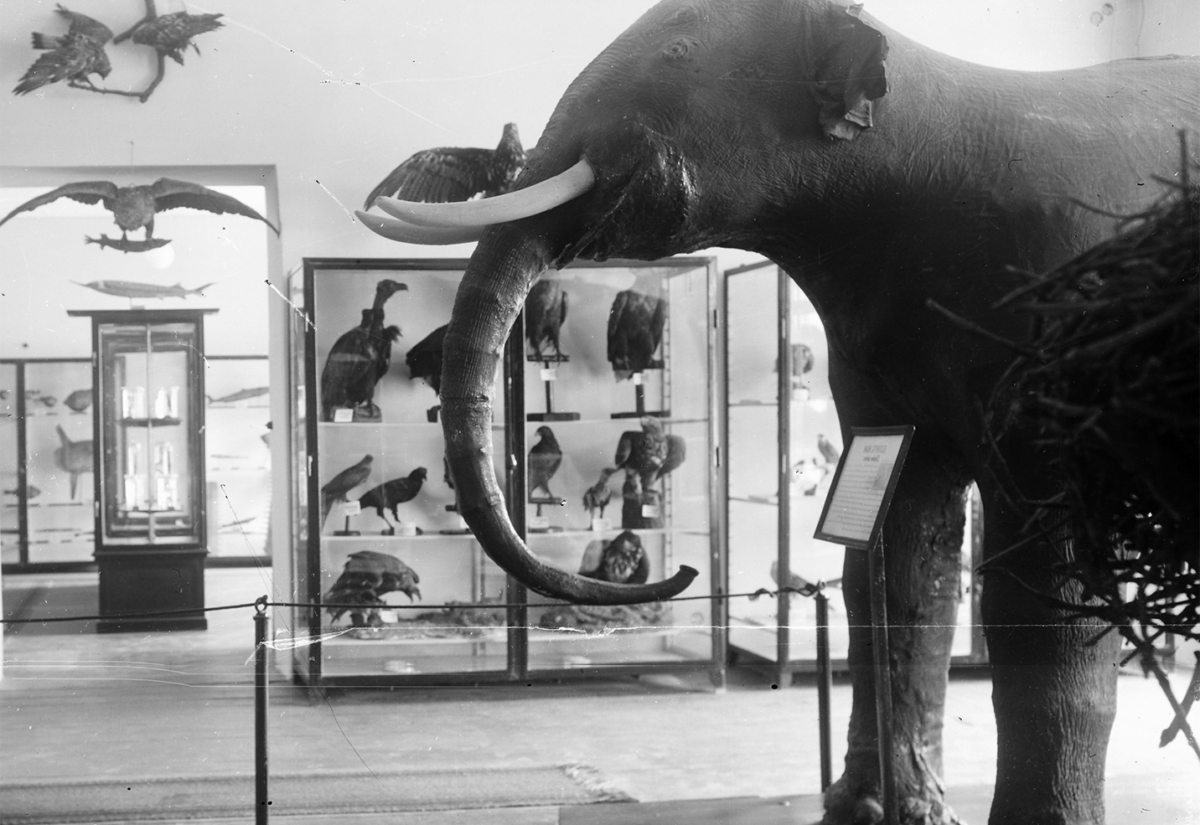
At the beginning of 1835, Gaba the elephant, who was on tour in Iași with the Luzzatto circus, died due to the harsh winter.
Mihail Sturdza (1794–1884), ruler of Moldavia, purchased the elephant for 135 galbeni (4,993 lei and 20 parale) to be displayed in the Royal Palace, but, at the request of Iacob Czihac (president of the Society of Doctors and Naturalists, founder of the Museum) and Gheorghe Asachi (trustee of the schools), the ruler agreed to donate the elephant to the Museum.
Around 1840, taxidermist Wilhelm Fleck cleaned and mounted the elephant skeleton, which was displayed in the museum’s main hall. Its presence, astonishing to the public of Iași at the time, led to the institution becoming known as the “Elephant Cabinet”.
The elephant’s skin was recovered from the roof of a house in Ciurchi only in 1858; having been dried for a quarter of a century, it had to be soaked for several months in the water basin in the museum square. Twenty-five years later, Franz Martin Kieser (1832–1898) from Aschaffenburg, Germany, brought in by Iacob Czihac as a taxidermist and curator of the museum, stuffed the skin of the elephant Gaba. Reconstructing the elephant’s body on a wooden and metal skeleton incurred additional costs of 1,845 piastres (the currency of the time). The glass eyes were added to the exhibit only in 1862, brought from Aschaffenburg, for another 78 lei.
On 12 December 1958, during restoration work on the elephant, a letter dated Jassy, October 1861 was found inside: “This elephant died in 1834 and the skin was prepared in October 1861. The locksmith from Siret built the skeleton, the furniture maker Ferdinand Klaruber from Prague, Bohemia, did the carpentry work, and I, Mathias Kieser from Aschaffenburg, Bavaria, a taxidermist, adjusted and mounted the skin.”
Jassy, October 1861
Between 1860 and 2023, the skeleton and stuffed body of the elephant, displayed in the museum’s main hall, were one of the institution’s most beloved exhibits.
In 2021, at the request of the Museum’s Scientific Council, the Rectorate of Alexandru Ioan Cuza University approved the disposal of the naturalised exhibit, which had been severely damaged by the passage of time. During the Second World War, the building was hit by incendiary bombs, and the elephant’s skin was irreversibly damaged, losing its texture and hairiness; it was subsequently repaired with plaster and painted several times.
Today, the Natural History Museum in Iași exhibits the original skeleton of the elephant Gaba, with authentic tusks. In 2024, it was cleaned and partially reconditioned, preparing this emblematic exhibit of the Museum for another long period of service in public education.


