


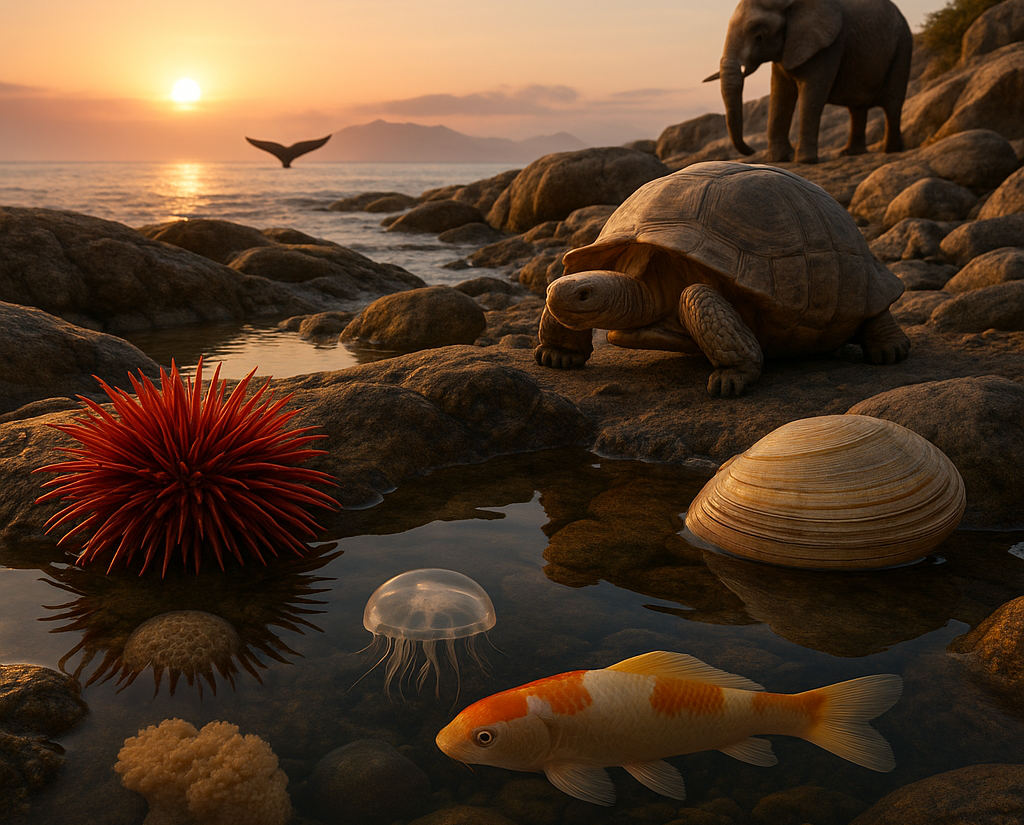
The immortal jellyfish (Turritopsis dohrnii)
It has no maximum age, as it can revert to its juvenile stage whenever it is injured or stressed. Thus, it has the biological potential to be immortal.
Sea sponges (Porifera)
They are considered the longest-living animal organisms known. Estimates for abyssal species of sea sponges reach 10-15,000 years!
Quahog clams (Arctica islandica)
To determine the age of a specimen, researchers count the stripes on the shell. The species generally lives between 100 and 400 years, but the record holder is the famous Ming, a shell found in Iceland in 2006, which was 507 years old.
The bowhead whale (Balaena mysticetus)
The bowhead whale is one of the largest and longest-living mammals on Earth. It lives for 150-200 years, exclusively in waters where krill (zooplankton) abounds in the Arctic Ocean.
Galápagos tortoise (Chelonoidis niger)
It is the longest-living land vertebrate. The most famous tortoise of this species is “Lonesome George”, who, at 100 years old, was still classified as a young adult, but the oldest tortoise was “Harriet”, who died at the age of 176 from heart disease.
Red sea urchin (Mesocentrotus franciscanus)
The small spiny animal lives on average 35 years, but if it manages to exceed this age, it can live up to 250 years. It is mostly immobile, living in small groups of 4-5 specimens.
African elephant (Loxodonta africana)
Elephant herds have a matriarchal structure, with the oldest female in charge. In the wild, elephants have an average lifespan of 60-70 years. Researchers can determine their age based on certain characteristics, such as size or number of teeth.
Koi carp
In general, koi carp do not live longer than 30 years, but in 1977 Hanako, the oldest specimen ever known, was discovered. It lived for 226 years, and its age was determined by counting its growth rings.


